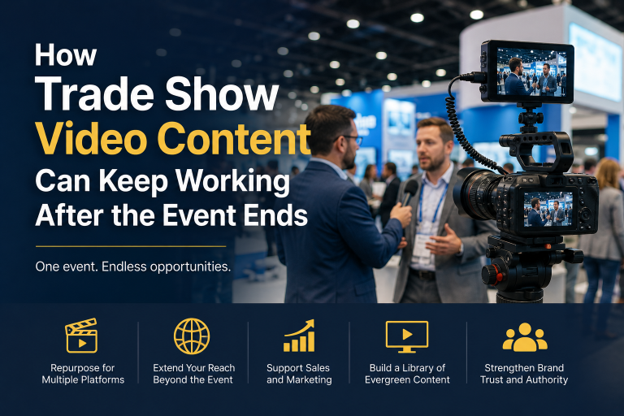
A trade show may last only a few days, but the video content created during those days can continue supporting a business long after the event is over. Instead of treating trade show footage as a simple recap, companies can use professional video production to create content that supports marketing, sales, social media, websites, and customer communication for months.
Interviews, product demonstrations, customer conversations, presentations, employee interactions, and behind-the-scenes footage can all become useful assets. With thoughtful planning, one trade show can provide enough material for multiple videos rather than producing a single recap that becomes outdated once the event ends.
Plan the Content Before the Event
The best trade show videos begin with a plan. Before filming starts, businesses should decide what they want the content to accomplish. A company launching a product may need demonstrations and product-focused interviews, while a business trying to establish industry expertise may benefit more from expert discussions, presentations, and customer conversations.
Creating a basic shot list can help ensure that important footage is captured. This does not mean every moment needs to be scripted. Trade shows are unpredictable, and some of the most useful footage can come from spontaneous conversations or interactions. The goal is simply to give the production team a clear understanding of what the business will need after the event.
Capture Content With Multiple Uses in Mind
A common mistake is filming only enough material for one highlight video. A better approach is to capture different types of footage that can later be separated into individual pieces of content.
Wide shots can establish the atmosphere of the trade show, while close-up footage can highlight products, displays, demonstrations, and important details. Interviews can provide educational information, while natural footage of employees and customers can make future videos feel more authentic.
This approach is an important part of professional event videography because the footage is captured with the final purpose in mind. Instead of simply documenting what happened, the filmmaker creates a collection of visuals that can support different marketing needs.
Turn Interviews Into Long-Term Content
Interviews are among the most versatile forms of trade show content. A single conversation with an executive, product specialist, or industry expert can produce several useful videos.
Instead of asking someone only to talk about the trade show, consider questions that will remain relevant after the event. What problems are customers facing? What changes are happening in the industry? What does the company offer? What makes its approach different? What should customers know before choosing a particular product or service?
The answers can later be edited into short social media clips, website videos, educational content, sales materials, or longer interviews. This makes the original investment in video production much more valuable.
Create Short Social Media Videos
Trade shows can provide a large amount of material for short-form social media content. A product demonstration, customer comment, employee interview, or interesting industry observation can become its own short video.
Businesses do not necessarily need to publish the entire event video at once. Instead, individual moments can be released over several weeks, helping the company maintain a steady stream of content after the event.
The footage can also be edited into different formats depending on where it will be published. Vertical versions may work well for mobile-focused platforms, while horizontal footage can be useful for websites, presentations, and longer videos.
Use Trade Show Footage on Your Website
Trade show content can continue working on a company's website long after the event. A product demonstration can help visitors understand an offering, while an expert interview can strengthen an educational or industry-focused page.
Customer testimonials recorded during the event can also provide valuable social proof. Rather than simply telling potential customers that a product works, a company can allow them to hear directly from people who have experienced it.
A professional video production team can capture footage in a way that gives editors enough flexibility to create both event-specific and evergreen content.
Give Sales Teams More Useful Follow-Up Content
Trade show follow-up does not have to consist entirely of emails and phone calls. Video can give sales teams another way to communicate with prospects.
A short product demonstration can be sent to someone who wants additional information. An expert interview can answer a common industry question. A customer testimonial can help address concerns during the purchasing process.
This is particularly useful for prospects who did not attend the trade show themselves. Video allows them to experience some of the information and demonstrations they would otherwise have missed.
Turn Presentations Into Educational Videos
Trade shows frequently include presentations, panel discussions, workshops, and demonstrations. With the appropriate permissions, these can become valuable educational content after the event.
A full presentation can be edited into a longer video, while individual sections can become shorter lessons or social media clips. Important statements can also be combined with supporting footage to create additional content.
This strategy allows businesses to demonstrate expertise instead of using every piece of content as a direct sales message. Educational videos can continue attracting viewers because the information remains useful beyond the date of the event.
Build a Reusable Video Library
One of the biggest long-term benefits of professional video production is creating a library of reusable footage. A single trade show can provide product shots, employee interviews, customer interactions, venue footage, demonstrations, presentations, and behind-the-scenes material.
Organized footage can be useful for future campaigns, website updates, presentations, recruitment materials, and social media. Marketing teams can return to the footage months later instead of scheduling a new shoot every time they need supporting visuals.
Businesses should also keep original files organized and backed up. Footage that was not used in the first edit may become valuable for a future campaign.
Don't Ignore Behind-the-Scenes Moments
Not every trade show video needs to look formal. Behind-the-scenes footage can show the people and preparation behind the business.
Employees setting up the booth, preparing products, traveling to the event, meeting customers, or discussing the day's activities can create more personal content for social media. These moments can make a company feel approachable and give audiences a better understanding of the people behind the brand.
Capturing authentic moments is also an important part of professional event videography. The same ability to remain observant and unobtrusive is valuable across many types of filming.
Choose a Videographer Who Understands Storytelling
Trade shows can be challenging environments for filming. Crowds, background noise, changing lighting, limited space, and unpredictable conversations can make it difficult to capture professional footage.
A skilled videographer needs to anticipate important moments while remaining flexible enough to react when something unexpected happens. Good audio is particularly important because an otherwise excellent interview can become difficult to use if the sound quality is poor.
These skills are also relevant to Seattle event videography, where filmmakers regularly work with unpredictable events, live audio, changing lighting, and important moments that cannot be repeated. A wedding videographer must capture genuine interactions without constantly interrupting them, and those same storytelling principles can be useful for corporate and trade show filming.
Connect Video With Your Marketing Strategy
Trade show footage becomes even more valuable when it connects with other marketing activities. An interview can accompany a blog article, a product demonstration can be added to a website page, and a customer statement can become part of an email campaign.
A longer presentation can also be turned into several educational clips. This creates a connected content strategy instead of treating every video as an isolated project.
The goal is to make the original filming investment work across as many relevant channels as possible.
Think About Future Use Before Filming
One of the simplest questions businesses can ask before a trade show is: How could we use this footage six months from now?
That question encourages the team to focus on content with lasting value. Instead of capturing only crowd shots and general event footage, the production can prioritize interviews, demonstrations, customer experiences, useful product visuals, and educational discussions.
The same philosophy applies to corporate event videography and other professional filming projects. Content should ideally be captured with multiple future uses in mind.
A trade show may end when the booths come down and attendees leave, but the content created there can continue working for a business long afterward. Interviews can become social clips, demonstrations can support product pages, presentations can become educational resources, and customer conversations can strengthen sales materials.
Professional video production allows businesses to capture these opportunities with better planning, sound, visuals, and storytelling. Effective event videography is not simply about documenting an event; it is about creating footage that can continue communicating the company's message after the event has finished.
The same storytelling principles found in Seattle event videography, authentic moments, careful observation, strong audio, and thoughtful editing, can also be valuable in corporate settings. Whether the project involves a trade show, conference, product launch, or another event, the most useful video is often the footage that continues providing value long after the cameras have been packed away.
About Us
Best Made Videos® is a Seattle-based, full-service video production company specializing in corporate video production, conference videography, trade show videography, convention coverage, and live event videography. With more than 18 years of experience, the team provides end-to-end production support, from planning and scripting to on-site filming, professional audio, post-production, and editing. Their conference services can include keynote and breakout-session recordings, recap videos, attendee and networking footage, testimonials, and branded B-roll, allowing organizations to create both engaging event recaps and useful long-term content. Best Made Videos® is led by Emmy-nominated photojournalist and videographer Reid Johnson and has produced video projects for organizations including Amazon, Microsoft, Salesforce, and other businesses throughout the Pacific Northwest.